
Signals, systems and the decisions between them.
Editorial analysis from zScale Intellect. Research is kept separate from governed product evidence; every operational claim still depends on its displayed source and method.
A factory is coming. What should the region do first?
Issue 13 · October 14, 2026
IEM’s planned San Antonio factory and Eaton’s Arkansas expansion offer a practical way to examine hiring needs, training capacity and coordination before production begins.
Read the issue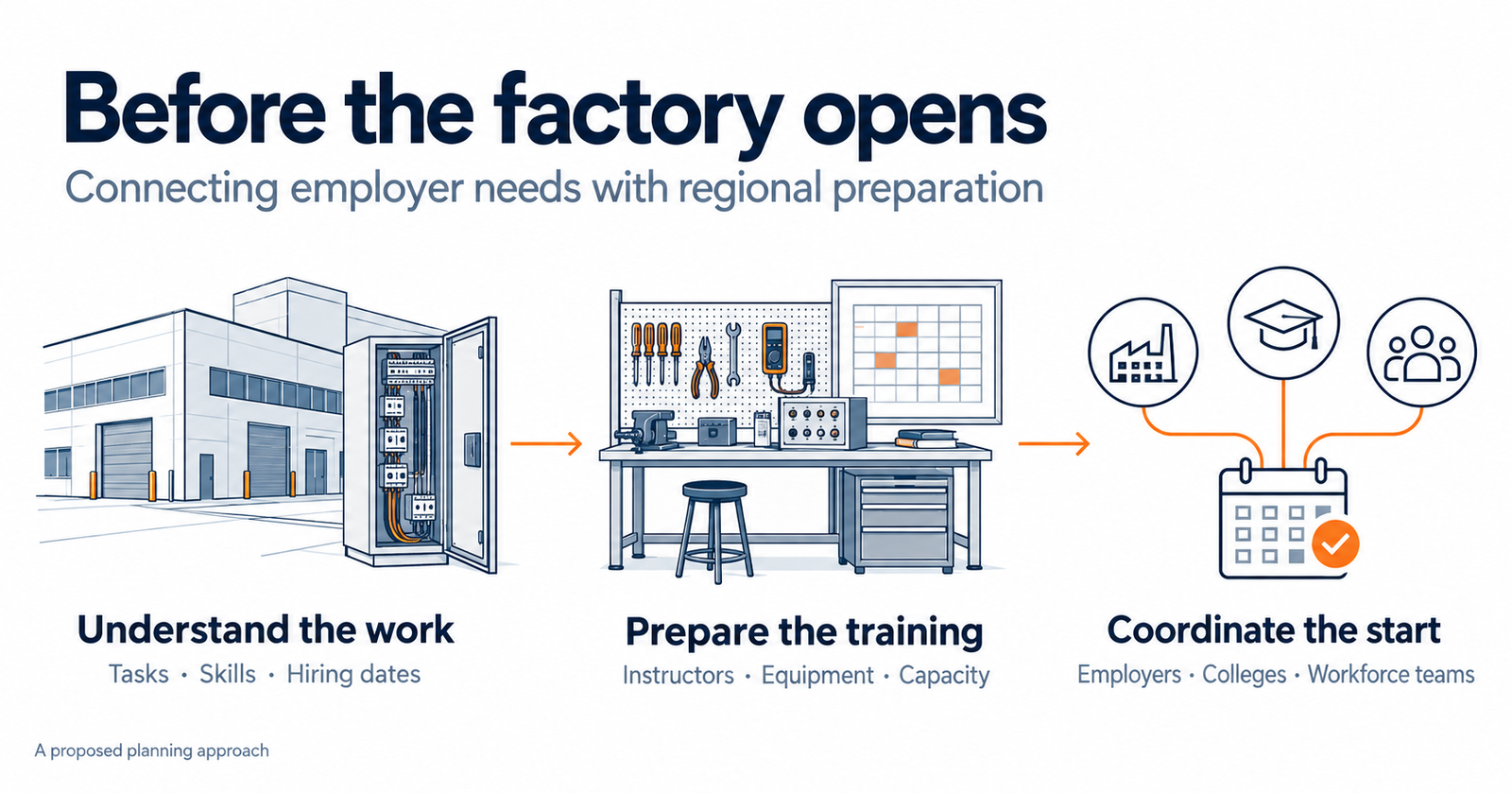
Published issues.
- 12
September 30, 2026 · 5 min read
Miami’s $2 billion campus bet raises a question for Texas
Carnegie Mellon’s Miami plans, Texas A&M–Fort Worth and concrete education partnerships raise a practical question about local participation.
- 11
September 17, 2026 · 4 min read
Workforce planning before the first hire
A practical first-hire planning framework for employers, EDCs, workforce boards and colleges, with a Wake Tech apprenticeship example.
- 10
September 3, 2026 · 5 min read
Texas Industrial Growth Is Reshaping Regional Workforce Demand
How Texas industrial parks are changing workforce demand and why colleges and workforce boards need to join the conversation before facilities open.
- 09
August 20, 2026 · 7 min read
Every Texas Region Is Asking the Same Workforce Question
Reflections from the Basic Economic Development Course, five Texas talent programs and the shared workforce questions emerging across different regions.
- 08
July 9, 2026 · 10 min read
TXSE on Y'all Street and AT&T on Legacy Drive just put DFW's corridor at full load.
AT&T committed $1.35 billion and 10,000 full-time employees on 54 acres of the former EDS campus in Plano. TXSE opened for trading in Dallas on July 8 with $275 million from BlackRock and Citadel Securities. Both moves stack on top of a corridor that has been carrying baseline demand from Toyota, JPMorgan Chase, Fidelity and Charles Schwab for years. The next 24 months are the window to size the pipeline.
- 07
June 25, 2026 · 9 min read
Only 4% of short-term programs will qualify for Workforce Pell.
The U.S. Department of Education published the final Workforce Pell rule on May 19, 2026. Early implementation opens July 1. North Carolina expects only about 4% of existing short-term programs to clear the initial screens. The 70/70 outcomes floor and the Value-Added Earnings cap will decide which programs keep federal aid access.
- 06
June 11, 2026 · 9 min read
Why does the job market feel broken even after 172,000 jobs were added?
May 2026 added 172,000 jobs, double the 85,000 economists forecast. Long-term unemployment is up 524,000 in a year. Entry-level tech hiring is down 73.4% while AI engineering postings grew 143% year over year. Workforce Pell goes live July 1 and the first HB8 downward adjustments hit Texas colleges in October.
- 05
May 28, 2026 · 10 min read
93% of students say they are ready. 54% of employers agree. That gap has a cost.
93% of students believe they are learning the skills they need. Only 54% of employers agree. 69% of recent graduates require significant additional training after being hired. The institutions and regions closing this gap with real-time workforce intelligence will have a measurable advantage in enrollment, hiring speed and economic competitiveness.
- 04
May 14, 2026 · 9 min read
Why talent now leads every site selection conversation in the top-performing regions
Texas landed 1,400+ business projects in 2025 with $75B in capital and 42,000 new jobs. The Area Development survey shows 100% of corporate respondents now rank skilled labor as important or very important. Workforce moved from slide 8 to slide 1.
- 03
May 1, 2026 · 12 min read
Are we training people for the jobs that are coming?
18% of U.S. firms have adopted AI but 78% of the labor force works at those firms. $700 billion is flowing into AI infrastructure in 2026. Georgetown CEW projects a 5.25 million skilled worker shortfall by 2032.
- 02
April 16, 2026 · 10 min read
A degree used to be a safety net. The data says it isn't anymore.
Recent grad unemployment hit 5.7% in Q4 2025 while overall unemployment held at 4.2%. Entry-level knowledge-work postings dropped 46-67% since 2018. Texas is building an alternative pipeline at scale with 40,000 active apprentices.
- 01
April 2, 2026 · 7 min read
What 52% graduate underemployment really means for universities right now
More than half of bachelor's degree graduates are underemployed within a year of finishing school and 45% remain so a decade later. The new OBBBA earnings test takes effect July 1, 2026. Most institutions aren't ready.